Overview
The railway system of the Republic of Belarus continues to play a critical role in the logistical support of both Belarusian and Russian armed forces. In 2025, a wide range of military transport passed through the infrastructure of the Belarusian Railway (BCh), reflecting current tasks of bilateral military-political and industrial cooperation. This transport includes the export of heavy equipment, deliveries of reinforced concrete structures, export-import of ammunition, rotation and return of military contingents, as well as maintenance and repair of armaments.
The minimization of volatility in commercial and transit freight flows makes military and military-industrial shipments an increasingly important segment of railway infrastructure utilization. At the same time, the nature of the cargo and recipients demonstrates sustained cooperation between Belarusian manufacturers, Russian defense industry enterprises, and military structures.
This material consolidates all military transport by railway that we have identified and documented for the period April–September 2025, systematizing data on shippers, consignees, destination stations, and cargo nomenclature.
The material is structured into eight analytical sections:
- Export of OJSC MZKT products to enterprises of the Russian defense industry.
- Deliveries of OJSC Spetszhelezobeton products (reinforced concrete sleepers and turnout bearers) to strategic facilities of the Ministry of Defence of the Russian Federation.
- Import into Belarus of explosive materials (EM) (ammunition) from Russian manufacturers.
- Transfer of equipment from storage of the Armed Forces of the Republic of Belarus in the interests of the Armed Forces of the Russian Federation and dispatch of Belarusian air defense systems for repair in the Russian Federation.
- Transport of bodies of deceased Ukrainian military personnel through the territory of Belarus.
- Deployment of units of the Armed Forces of the Republic of Belarus to Russian training ranges for combat training.
- Dispatch of Air Force and Air Defense units of the Republic of Belarus and rocket artillery to the Ashuluk and Kapustin Yar ranges.
- Movement of Russian troops to Belarus and back within the framework of the strategic exercises “Zapad-2025” and CSTO exercises.
This material is a logical continuation of our report for Q1 2025 — “Export of Products from Belarus to Strategic Facilities of the Russian Federation and Import of Russian Armed Forces Equipment into Belarus, Q1 2025”, which covered the first three months of 2025 and already highlighted the initial volume of export deliveries.
I. Deliveries of OJSC MZKT Products within Russian-Belarusian Military-Technical Cooperation in Q2 and Q3 2025
This section presents updated information on the volume of export railway deliveries of specialized equipment and machinery produced by the Open Joint-Stock Company “Minsk Wheeled Tractor Plant” (OJSC MZKT) for the period April–September 2025. It also provides information on the structure of shipped cargo according to the ETSNG nomenclature and on recipient enterprises in the Russian Federation.
The material is a continuation of previously published analytical reviews devoted to the dynamics of export transport via the Belarusian Railway. Previous publications examined in detail the volume of MZKT railway shipments for the first quarter of 2025, as well as cumulative figures for nine months and for the entire year 2024.
As a reminder, for January–March 2025 (Q1), 93 railcars with MZKT equipment and products were dispatched from Shabany station. For the nine months of 2024, the volume of export railway deliveries totaled 200 railcars, and for the entire year 2024 — 306 railcars. Virtually all shipments were directed to Russian enterprises, a significant portion of which belong to the defense industry of the Russian Federation.
The volume of MZKT export railway shipments in various periods may be influenced by a number of external and organizational factors. Such factors include, in particular, the schedules for fulfilling contracts with Russian industrial enterprises, the periodicity of production cycles and the utilization of main production capacities, the regularity of order placement within the framework of defense industry cooperation, as well as the specifics of transport logistics planning. In addition, the distribution of deliveries by month may be affected by deadlines for delivery of finished products to customers, the formation of export batches, the specifics of the nomenclature of shipped products, and requirements for their transport documentation.
In total, for the period from April to September 2025, to addresses of Russian defense industry enterprises from Shabany station of the Minsk Division (NOD-1) of BCh, 135 railcars (excluding buffer boxcars) loaded with OJSC MZKT equipment were dispatched.
The volumetric distribution of types of cargo shipped from Shabany station by OJSC MZKT (in accordance with the Unified Tariff and Statistical Nomenclature of Goods — ETSNG) for the period from April to September 2025 is as follows:
- Trucks, not specified in the directory (ETSNG code 381072) — 100 railcars.
- Automobile trailers (ETSNG code 381231) — 18 railcars.
- Means of transportation, not specified in the directory (ETSNG code 391303) — 17 railcars.
Below are detailed data on destination stations and final recipients in the Russian Federation of products from OJSC MZKT for the period April–September 2025, dispatched from Shabany station of the Minsk Division (NOD-1) of BCh:
- To Traktornaya-Tovarnaya station (Privolzhskaya Railway) addressed to JSC Federal Scientific and Production Center “Titan-Barrikady”, 35 flatcars were dispatched with cargo “Trucks, not specified in the directory.”
- To Kostarikha station (Gorky Railway) addressed to JSC Nizhny Novgorod Plant of the 70th Anniversary of Victory, 22 railcars were dispatched, including: 14 flatcars with cargo “Trucks, not specified in the directory,” 6 flatcars with cargo “Automobile trailers,” and 2 flatcars with cargo “Means of transportation, not specified in the directory.”
- To Perm-I station (Sverdlovskaya Railway) addressed to JSC Special Design Bureau, 22 flatcars were dispatched with cargo “Trucks, not specified in the directory.”
- To Kostarikha station (Gorky Railway) addressed to JSC Nizhny Novgorod Television Plant named after V. I. Lenin (JSC NITEL), 6 flatcars were dispatched with cargo “Automobile trailers.”
- To Syzran-I station (Kuybyshev Railway) addressed to JSC TYAZHMASH, 21 railcars were dispatched, of which: 6 flatcars with cargo “Automobile trailers” and 15 flatcars with cargo “Means of transportation, not specified in the directory.”
- To Sankt-Peterburg-Sort.-Moskovskiy station (Oktyabrskaya Railway) addressed to JSC GOZ Obukhovsky Plant, 16 flatcars were dispatched with cargo “Trucks, not specified in the directory.”
- To Shumerlya station (Gorky Railway) addressed to JSC Shumerlinsky Plant of Specialized Automobiles, 6 flatcars were dispatched with cargo “Trucks, not specified in the directory.”
- To Mark station (Moscow Railway) addressed to PJSC NPO Almaz, 5 flatcars were dispatched with cargo “Trucks, not specified in the directory.”
- To Vozhoy station (Gorky Railway) addressed to JSC IEMZ Kupol, 1 flatcar was dispatched with cargo “Trucks, not specified in the directory.”
- To Ulyanovsk-III station (Kuybyshev Railway) addressed to JSC Ulyanovsk Mechanical Plant (JSC UMZ), 1 flatcar was dispatched with cargo “Trucks, not specified in the directory.”

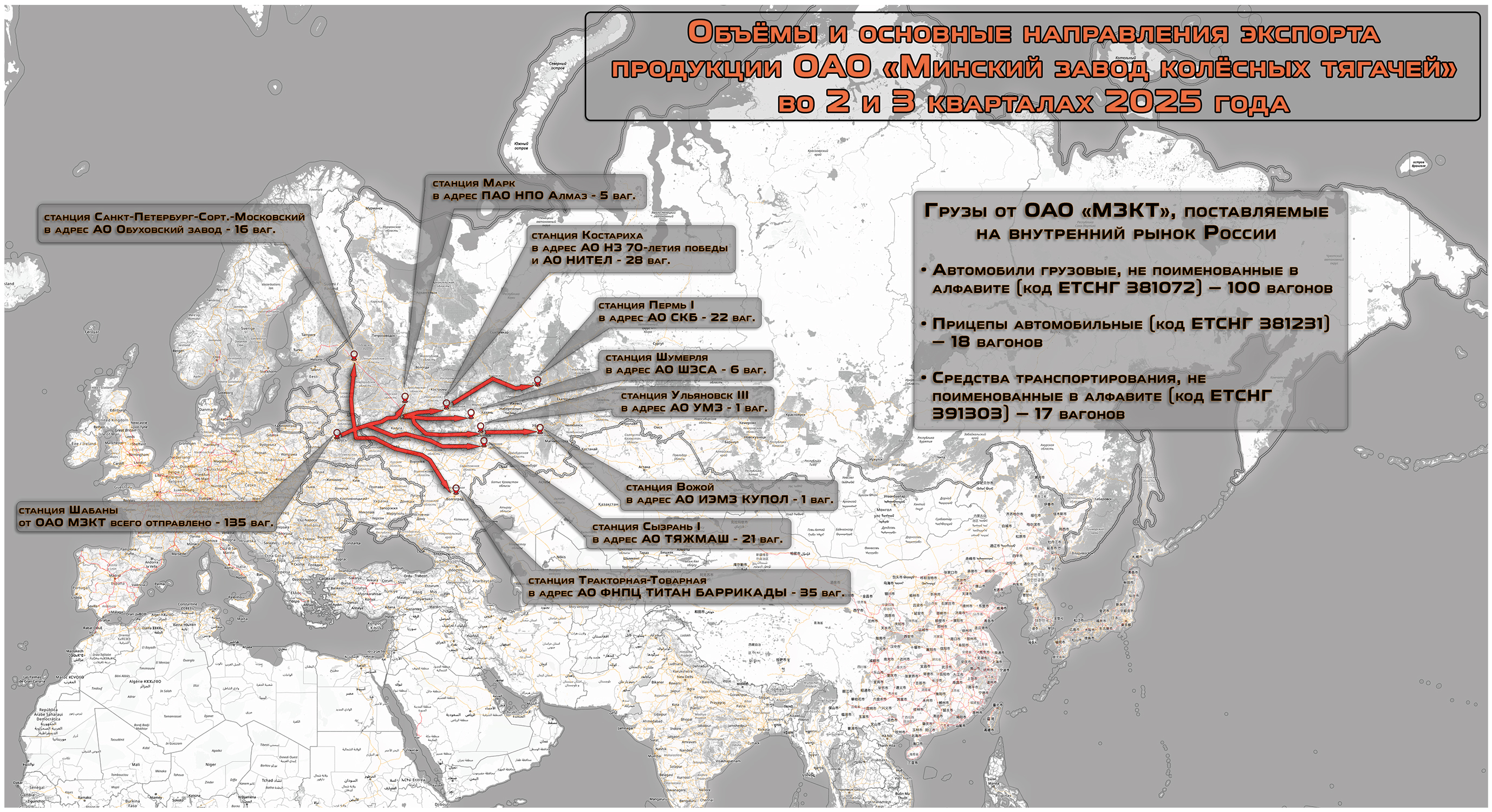
For Q2–Q3 2025, 135 railcars with OJSC MZKT products were dispatched from Shabany station. Including the 93 railcars dispatched in Q1, the total volume of export railway deliveries for the period from January 1 to September 30, 2025, amounted to 228 railcars. This is 28 railcars more than for the nine months of 2024 (200 railcars), indicating the continuation of significant volumes of Belarusian heavy equipment deliveries to Russian defense industry enterprises.
If we consider the dynamics by quarter, the level of shipments remains consistently high: in Q1 2025, 93 railcars were dispatched (an average of about 31 railcars per month), while in Q2–Q3 — 135 railcars (approximately 22–23 railcars per month). Thus, the volume of deliveries is distributed relatively evenly, and the observed fluctuations are explained by the calendar of contract execution and the periodicity of forming export batches.
The main recipients of MZKT products in January–September 2025 remained Russian defense industry enterprises specializing in the production of missile, anti-aircraft, artillery, and precision systems. Among them are manufacturers of launch systems, radar complexes, air defense systems, artillery systems, as well as plants producing specialized chassis, transport-launch equipment, engineering equipment, and onboard electronics components. Such specialization of recipients determines the constant demand for MZKT heavy wheeled platforms used as base chassis for mobile weapon systems.
The complete list of recipient enterprises of MZKT products for three quarters of 2025, with a comparison of data for nine months of 2024, is as follows:
- JSC GOZ Obukhovsky Plant — 53 railcars (31 railcars for nine months of 2024);
- JSC FNPC Titan-Barrikady — 48 railcars (36 railcars for nine months of 2024);
- JSC Special Design Bureau — 36 railcars (36 railcars for nine months of 2024);
- JSC NZ 70th Anniversary of Victory — 24 railcars (13 railcars for nine months of 2024);
- JSC TYAZHMASH — 22 railcars (27 railcars for nine months of 2024);
- JSC ShZSA — 17 railcars (28 railcars for nine months of 2024);
- JSC NITEL — 9 railcars (9 railcars for nine months of 2024);
- JSC IEMZ Kupol — 8 railcars (8 railcars for nine months of 2024);
- PJSC NPO Almaz — 7 railcars (12 railcars for nine months of 2024);
- JSC GKNPC named after M. V. Khrunichev — 2 railcars (no deliveries recorded for nine months of 2024);
- JSC UMZ — 2 railcars (no deliveries recorded for nine months of 2024).
Comparison with data for the nine months of 2024 shows that the structure of final recipients maintains continuity; however, some enterprises received a smaller volume of products, while growth was recorded in certain areas. These changes may be related to the completion of individual contracts, adjustments to product nomenclature, or redistribution of orders within the framework of Russian-Belarusian military-technical cooperation.
Summarized information on the nomenclature of cargo dispatched in January–September 2025 confirms the stability of the commodity structure:
- Trucks (ETSNG code 381072) — 186 railcars;
- Automobile trailers (ETSNG code 381231) — 23 railcars;
- Means of transportation (ETSNG code 391303) — 18 railcars;
- Railway cars transported on their own axles (ETSNG code 421034) — 1 railcar.
Overall, for January–September 2025, the export of MZKT equipment to the Russian Federation amounted to 228 railcars, which exceeds the figures for the same period last year by approximately 14% and indicates the continuation of high-intensity deliveries and stable plant utilization within the framework of military-technical cooperation between Belarus and Russia.
II. Deliveries of OJSC Spetszhelezobeton Products to Strategic Facilities of the Ministry of Defence of the Russian Federation in Q2 and Q3 2025
This section examines the military segment of export deliveries of OJSC Spetszhelezobeton products from Belarus to the Russian Federation for the period April–September 2025, in conjunction with previously analyzed volumes for the entire year 2024 and the first quarter of 2025.
This concerns a specialized type of cargo — “Reinforced concrete sleepers and turnout bearers” (ETSNG code 254159). Such products are used on the most critical sections of railway infrastructure: in station throats, yards, on internal tracks of industrial and military facilities, where the formation and rearrangement of trains, shunting operations, and delivery of railcars directly to arsenals, storage facilities, and technical positions are required.
OJSC Spetszhelezobeton (Mikashevichi) is one of the largest manufacturers of reinforced concrete structures in the region. A significant portion of the enterprise’s products is oriented toward the civilian sector (construction, industrial and transport infrastructure); however, this material analyzes only those deliveries identified as addressed to military units, arsenals, training ranges, military research institutes, and strategic defense industry enterprises of the Russian Federation.
For the year 2024, from Sitnitsa station (Baranovichi Division of BCh) to facilities of the Ministry of Defence of the Russian Federation, 149 gondola cars of sleepers and turnout bearers with a total mass of approximately 9,238 tonnes were dispatched. In the first quarter of 2025, the volume of such deliveries already amounted to 89 gondola cars, or about 5,518 tonnes, meaning approximately 60% of the 2024 annual level was achieved in just three months. This indicated high intensity of construction and upgrade work on railway infrastructure at a number of military and near-military facilities in the Russian Federation.
In the second and third quarters of 2025, the volume of deliveries to the military segment decreased noticeably and amounted to 12 gondola cars with a total mass of approximately 744 tonnes; however, the geography and nature of recipients show that even the reduced flow is still directed to narrowly specialized and strategically significant facilities.
Below are detailed data on destination stations and final recipients in the Russian Federation of OJSC Spetszhelezobeton products for the period April–September 2025, dispatched from Sitnitsa station of the Baranovichi Division (NOD-2) of BCh:
- To Torzhok station (Oktyabrskaya Railway) addressed to State Institution Military Unit 42753 (Railway Troops), 6 gondola cars were dispatched, with a total weight of ≈372 tonnes.
* Railway Troops of the Ministry of Defence of the Russian Federation (Torzhok, military unit 42753) — a military engineering formation engaged in the construction and restoration of railway infrastructure. Used in the deployment and supply of troops, including strategic facilities.
- To Kalishche station (Oktyabrskaya Railway) addressed to FSUE Research and Technological Institute named after A.P. Alexandrov (NITI named after A.P. Alexandrov), part of the Rosatom State Corporation, 4 gondola cars were dispatched, with a total weight of ≈248 tonnes.
* FSUE NITI named after A.P. Alexandrov (Rosatom) — the leading research center of Rosatom State Corporation, specializing in the development, testing, and technical support of nuclear power plants for the Russian Navy, including reactor installations for nuclear submarines and surface vessels. The institute conducts resource testing, material research, operational preparation of reactor installations, and their upgrade. It has the status of one of the key facilities of the Russian nuclear complex with restricted access and critically important infrastructure.
- To Plesetskaya station (Northern Railway) addressed to military unit 13991 (First State Test Cosmodrome of the Ministry of Defence of the Russian Federation, ZATO Mirny), 1 gondola car was dispatched, with a total weight of ≈62 tonnes.
* First State Test Cosmodrome of the Ministry of Defence of the Russian Federation (ZATO Mirny) — the central site for testing intercontinental ballistic missiles (ICBMs) in the interests of the Strategic Rocket Forces and space forces. Conducts flight testing of new types of strategic armaments, including missiles of the Topol-M, Yars, Avangard complexes, and prospective ICBMs. Also used for launching military satellites and dual-use spacecraft. Subordinate to the 33rd Research Institute of the Ministry of Defence of the Russian Federation.
- To Severodvinsk station (Northern Railway) addressed to JSC Production Association Sevmash (part of JSC United Shipbuilding Corporation), 1 gondola car was dispatched, with a total weight of ≈62 tonnes.
* JSC Production Association Sevmash (USC) — Russia’s largest shipbuilding enterprise and the only shipyard constructing nuclear submarines of all classes for the Russian Navy, including strategic missile carriers of the Borei-A projects and multipurpose nuclear submarines of the Yasen-M type. In addition to military shipbuilding, Sevmash performs deep modernization of operational nuclear submarines, produces offshore platforms, and special products. The enterprise possesses unique closed full-cycle infrastructure and is among the key facilities of Russia’s defense industry.
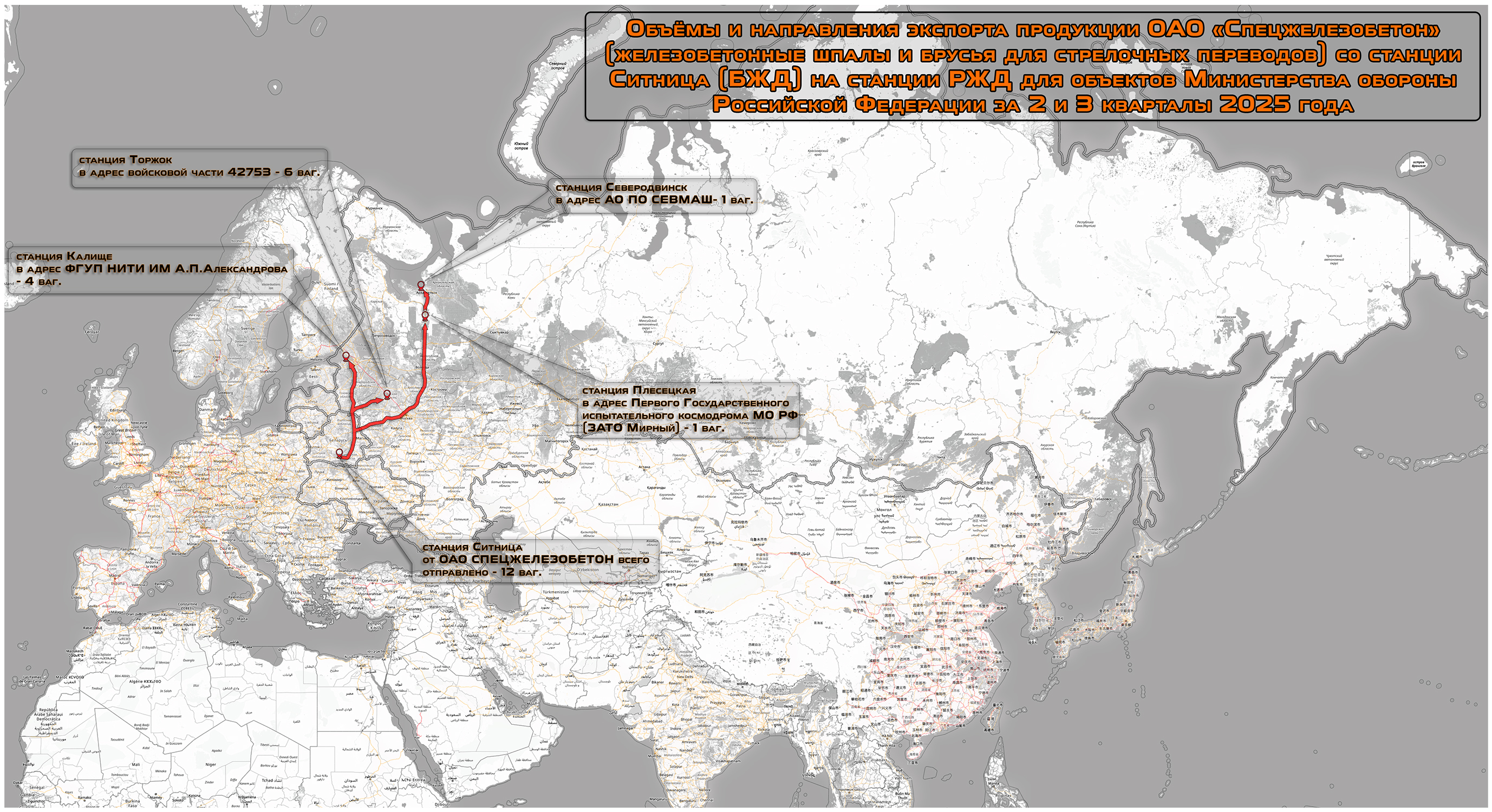
Thus, in Q2–Q3 2025, to military and related facilities in the Russian Federation, 12 gondola cars with a total mass of approximately 744 tonnes were dispatched. Combined with previously recorded deliveries for the first quarter (89 railcars / ~5,518 tonnes), this gives a total for January–September 2025:
- 101 gondola cars of reinforced concrete sleepers and turnout bearers;
- total mass — approximately 6,262 tonnes.
For comparison, for the entire year 2024, the same categories of military and strategic recipients accounted for 149 railcars with a total weight of approximately 9,238 tonnes. Thus, in the nine months of 2025, the volume of deliveries to the military segment reached approximately two-thirds of the 2024 level — both in terms of number of railcars and tonnage (about 68% of last year’s figures).
The statistics under consideration concern only identified deliveries to military units, arsenals, training ranges, R&D structures, and defense shipyards. OJSC Spetszhelezobeton simultaneously carries out significant volumes of shipments to the civilian sector, which are not analyzed in this material.
The nature of recipients in 2024, in the first quarter of 2025, and in the second–third quarters of 2025 shows continuity of the logistics scheme: Belarusian reinforced concrete sleepers and bearers are consistently directed to facilities associated with the missile-nuclear complex, military space infrastructure, naval shipbuilding, and support of military railway infrastructure. The difference between the “peak” first quarter and the more modest volumes of the second–third quarters reflects, above all, the phased nature of large construction-installation and upgrade projects, rather than the cessation or curtailment of cooperation.
Given the dynamics of 2024 and the nature of the recovery of deliveries in previous periods, it can be assumed that in the fourth quarter of 2025, the volume of shipments to military and near-military facilities will again show growth — within the framework of the next cycle of infrastructure work and closing of annual contracts — and in aggregate will exceed the 2024 figures.
III. Railway Transport of Explosive Materials (EM) Between the Republic of Belarus and Russia in Q2 and Q3 2025
In previous thematic publications, the dynamics of mutual transport of explosive materials (EM) between Belarus and the Russian Federation was examined in detail, including the recorded bilateral exchange of ammunition supplied both to the Ministry of Defence of the Republic of Belarus and to GRAU arsenals of the Ministry of Defence of the Russian Federation in 2025. The corresponding data, routes, and volumes are analyzed in the following materials:
- Import of a Large Batch of Ammunition into Belarus (September 2025);
- Resumption of Export of Ammunition from Belarusian Arsenals to the Russian Federation;
- Summary Volumes of Import and Export of Ammunition in September 2025.
This section supplements the previously presented picture with information on the import (into Belarus) of explosive materials (EM) in the second and third quarters of 2025. These data have not been published previously and allow clarification of the overall statistics of ammunition movement for the period April–September 2025.
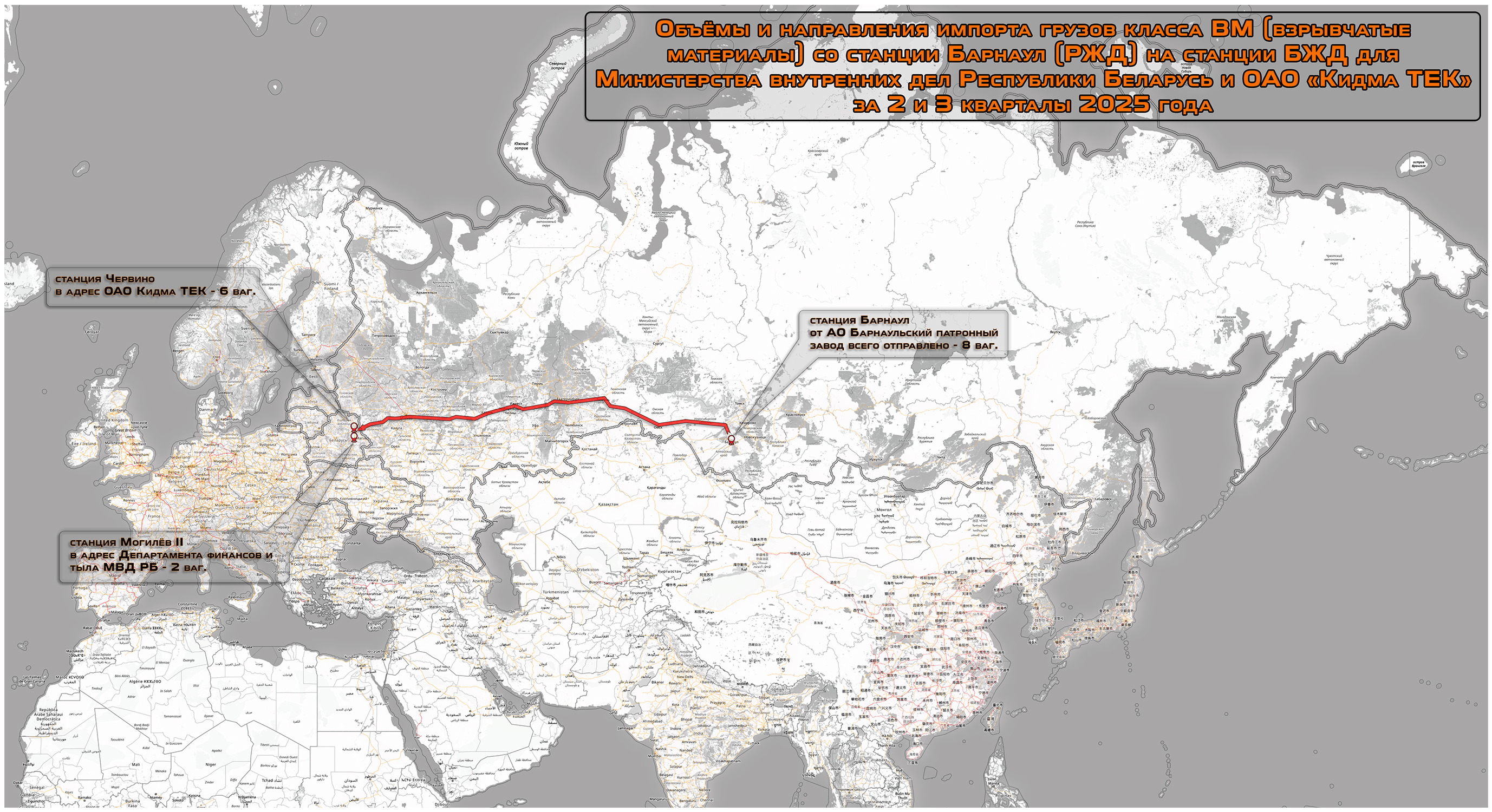
From Barnaul station (West Siberian Railway), shipper — JSC Barnaul Cartridge Plant*, to Belarusian recipients for the period April 1–September 30, 2025, the following transports were carried out:
- to Cherveno station (Minsk Division of BCh) addressed to OJSC Kidma Tek**, 6 railcars were dispatched, of which: 5 boxcars with cargo: Explosive materials (cartridges for small arms) and 1 buffer boxcar for explosive materials;
- to Mogilev-II station (Mogilev Division of BCh) addressed to the Department of Finance and Logistics of the Ministry of Internal Affairs of the Republic of Belarus, 2 boxcars were dispatched with cargo Explosive materials (cartridges for small arms).
For reference:
* JSC Barnaul Cartridge Plant is one of the largest ammunition manufacturers in Russia, specializing in cartridges for small arms for military and civilian use. The plant makes a wide range of ammunition for assault rifles, machine guns, rifles and pistols, including the army calibers 5.45×39, 7.62×39 and 7.62×54R, as well as hunting and sporting cartridges. It is a regular supplier to the Ministry of Defence of the Russian Federation, security agencies and state customers, and is one of the leading enterprises of the Russian cartridge industry.
** OJSC Kidma Tek — a Belarusian enterprise subordinate to the State Military-Industrial Committee of the Republic of Belarus, specializing in the production and supply of a wide range of personal protective equipment, gear, and components for the country’s law enforcement agencies. The enterprise produces body armor, protective helmets, elements of load-bearing systems, combat gear, covers and pouches for various types of weapons, as well as auxiliary products for storage and transport of ammunition and special property.
The company’s products are supplied to units of the Ministry of Defence, Ministry of Internal Affairs, and other law enforcement agencies of the Republic of Belarus, forming part of the internal system of material and technical support for Belarusian law enforcement structures.
The production facilities of OJSC Kidma Tek are distributed across several sites:
– Minsk — the administrative and production center, where design departments and bureaus for the development of new gear and special-purpose products are concentrated.
– Stankovo (Dzerzhinsky District) — the territory of a former military unit, where workshops for the repair of weapons and equipment, production lines for small arms, and infrastructure for conducting tests (shooting range and training grounds) are located.
– Orsha — a site based on a former laboratory for testing solid rocket fuels and propellants. Here operates a testing center capable of conducting a full range of ballistic and physicochemical tests of ammunition and rocket components, as well as workshops for scheduled maintenance and repair of high-precision products and assembly of lightly armored vehicles.
In addition to producing gear, the enterprise performs repair and maintenance of aviation guided missiles R-60, R-73, and R-27 for the Ministry of Defence of the Republic of Belarus and foreign customers, and also carries out repair and upgrade of 9M114 Shturm anti-tank guided missiles.
IV. Export of Military Equipment from Storage in the Republic of Belarus to the Russian Federation and Dispatch of Belarusian Air Defense Systems for Repair in the Russian Federation in Q2 and Q3 2025
This section provides information on recorded railway movements of military equipment from the territory of the Republic of Belarus to the Russian Federation in the period from April 1 to September 30, 2025. This concerns two separate categories of transport:
- transfer to the Russian side of equipment previously held in long-term storage in the Armed Forces of the Republic of Belarus;
- dispatch of Belarusian air defense missile systems for overhaul and scheduled maintenance at Russian specialized facilities.
Both identified trains relate to military-technical cooperation measures between the Republic of Belarus and the Russian Federation, but perform different functional roles — from the transfer of equipment in the interests of the Armed Forces of the Russian Federation to the extension of the service life of Belarusian air defense armaments.
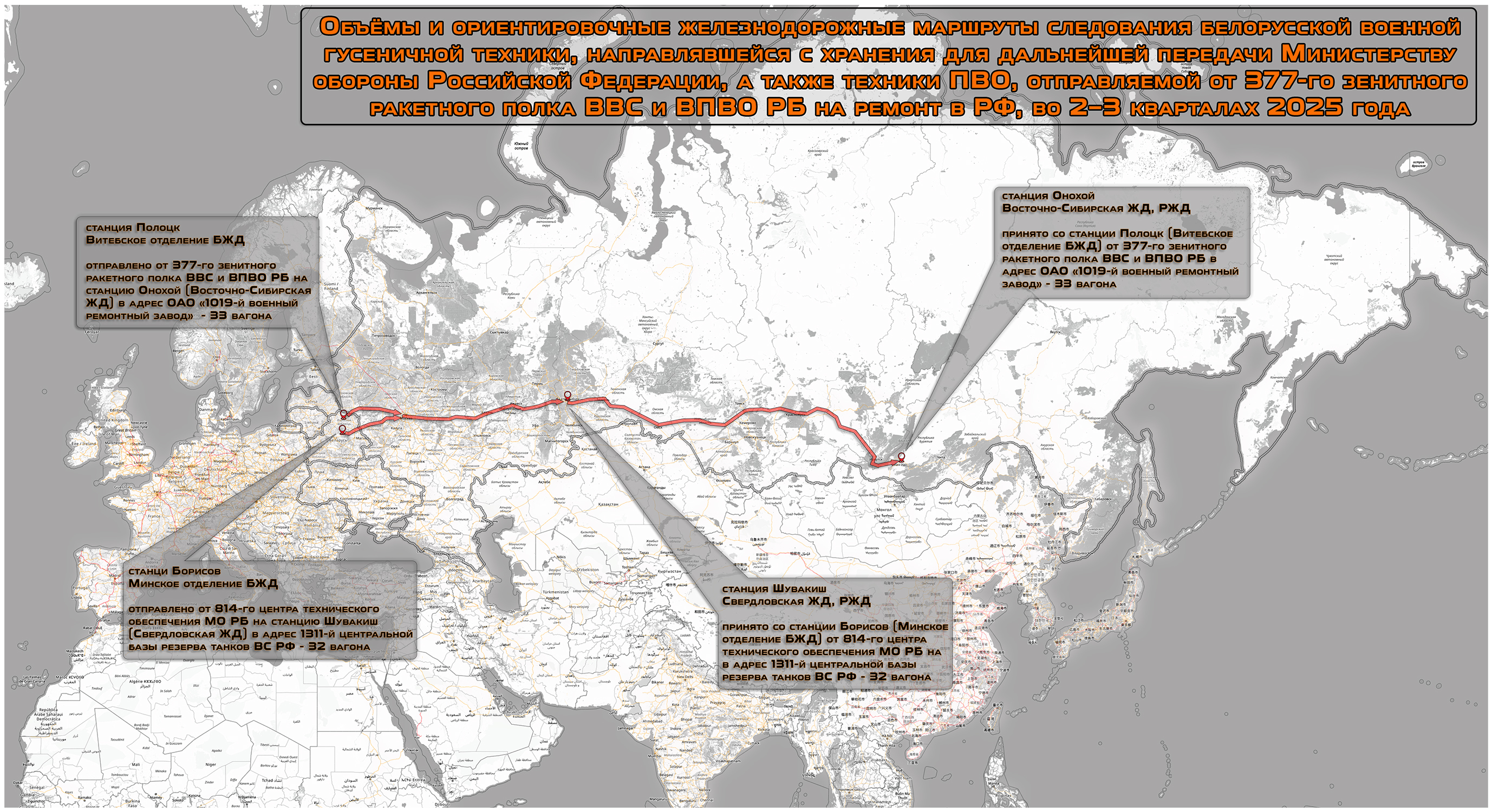
- Transfer to the Russian side of equipment from storage of the Ministry of Defence of the Republic of Belarus:
From Borisov station (Minsk Division of BCh) from the 814th Technical Support Center of the Ministry of Defence of the Republic of Belarus (military unit 32377) to Shuvakish station (Sverdlovskaya Railway) addressed to the 1311th Central Tank Reserve Base of the Armed Forces of the Russian Federation (military unit 42716), a troop train was dispatched, consisting of 32 railcars, of which:
- 31 flatcars loaded with military equipment,
- 1 boxcar for escorts.
The 1311th Base is one of Russia’s largest centers for long-term storage, scheduled maintenance, and subsequent formation of reserve sets of armored vehicles for the needs of the Armed Forces of the Russian Federation. The nature of the train composition and the final recipient allow this shipment to be unambiguously classified as the actual transfer of equipment from storage of the Ministry of Defence of the Republic of Belarus to the disposal of the Russian army. Similar movements have been recorded in previous years and are part of a systematic process of releasing Belarusian armament reserves in favor of the Armed Forces of the Russian Federation.
- Dispatch of Belarusian air defense systems for repair and scheduled maintenance in the Russian Federation:
From Polotsk station (Vitebsk Division of BCh) from the 377th Anti-Aircraft Missile Regiment of the Air Force and Air Defense of the Republic of Belarus (military unit 55719) to Onokhoy station (East Siberian Railway) addressed to OJSC 1019th Military Repair Plant (military unit 28098), a troop train was dispatched, including 33 railcars, of which:
- 31 flatcars loaded with military equipment (air defense system components),
- 1 gondola car with components for air defense missile systems,
- 1 boxcar with escorts.
OJSC 1019th Military Repair Plant is one of the key enterprises of the Ministry of Defence of the Russian Federation, performing deep repair and upgrade of medium-range air defense systems. Thus, this shipment represents the scheduled dispatch of Belarusian air defense systems for factory maintenance and scheduled repair.
V. Transport of Bodies of Deceased Ukrainian Military Personnel by Railway Through the Territory of the Republic of Belarus in June–July 2025
During the analyzed period, the transport by railway of bodies of deceased Ukrainian military personnel through the territory of the Republic of Belarus was carried out. The transport was conducted by the Russian side within the framework of repatriation procedures and preparation for the subsequent exchange of bodies between the Russian Federation and Ukraine according to agreements reached at negotiations in Istanbul. The transport was carried out from an area under the control of Russian forces.
The transport was carried out by two troop trains in the period June–July 2025 along the following route:
- Departure station: Uspenskaya (North Caucasus Railway) — a border station through which the Russian side processes the export of cargo arriving from Russian-controlled areas of Donetsk and Luhansk oblasts (ORDLO).
- Shipper: FKU United Strategic Command of the Southern Military District.
- Destination station: Novobelitskaya (Gomel Division of BCh).
- Consignee: Military Communications Directorate of the Republic of Belarus (UVSO RB).
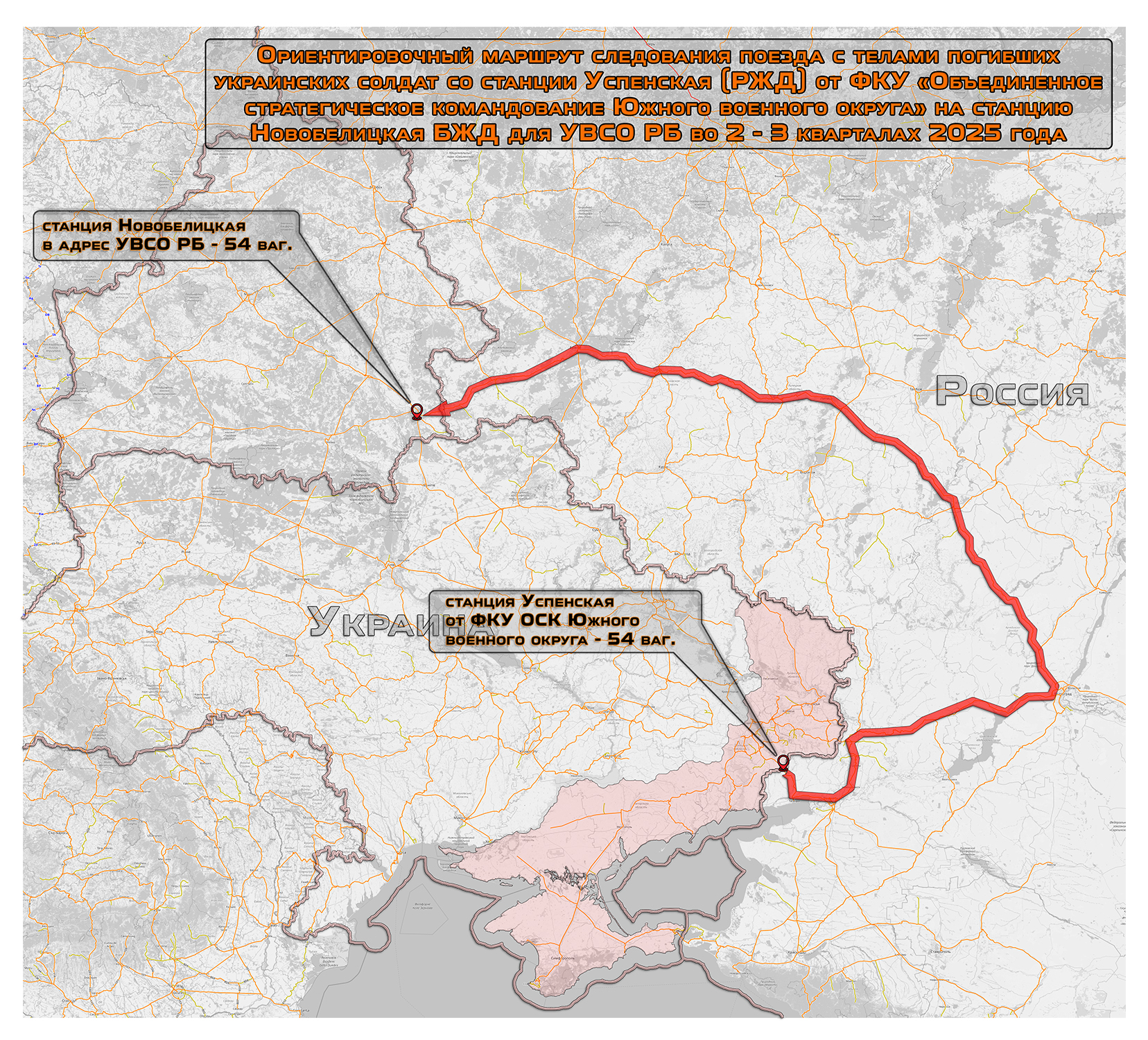
The total volume of the two recorded trains amounted to 54 flatcars, of which:
- 36 flatcars with large-tonnage refrigerated containers — 2 containers per flatcar;
- 18 buffer flatcars, intended for accompanying and ensuring the safety of transport of special-category cargo.
The implemented transport was carried out using flatcars and refrigerated containers owned by JSC Federal Freight Company (FGK).
VI. Railway Transport of Military Equipment of the Republic of Belarus for Participation in Combat Training Activities at the 333rd Combat Training Center of the Armed Forces of the Russian Federation and Its Return to the Republic of Belarus (April–September 2025)
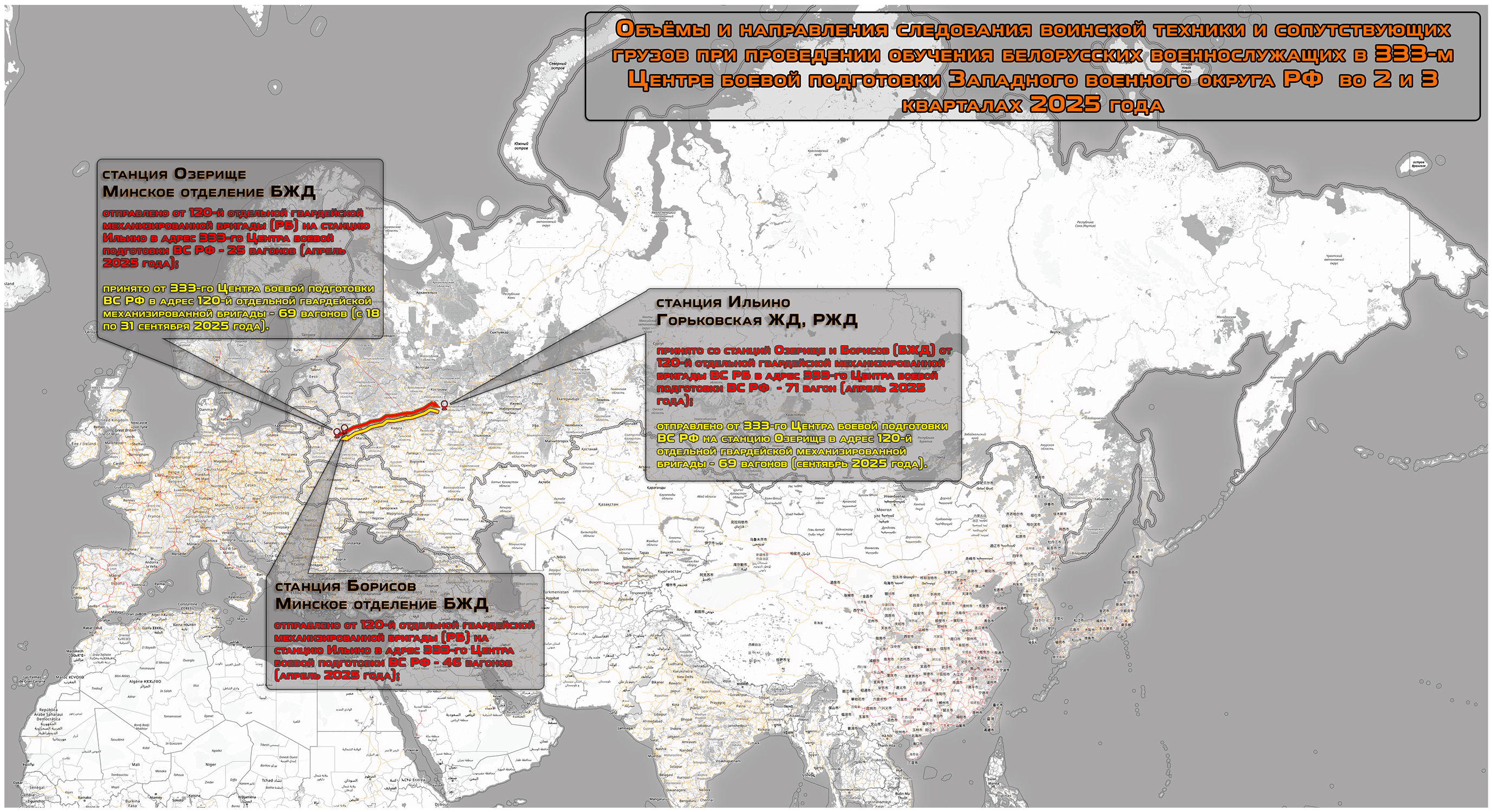
In the period from April to September 2025, organized railway transports of contingents and military equipment of the 120th Separate Guards Mechanized Brigade of the Armed Forces of the Republic of Belarus were recorded, directed to participate in combat training activities at the 333rd Combat Training Center of the Ground Forces, Airborne Forces, and Coastal Troops of the Navy of the Western Military District of the Russian Federation (military unit 74036).
The transportation included two stages — the withdrawal of units in April 2025 and their return to the Republic of Belarus at the end of September 2025.
The departure (withdrawal) from Belarus was carried out by two troop trains in April 2025 (excluding passenger cars with personnel):
- From Ozerishche station (Minsk Division of Belarusian Railway), a troop train of the Armed Forces of the Republic of Belarus, consisting of 25 railcars, was dispatched from the 120th Separate Guards Mechanized Brigade of the Armed Forces of the Republic of Belarus (military unit 04147) to Ilyino station (Gorky Railway) for the 333rd Combat Training Center of the Armed Forces of the Russian Federation (military unit 74036). This included: 21 flatcars with military equipment loaded and 4 boxcars with gear.
- From Borisov station (Minsk Division of Belarusian Railway), a second troop train of the Armed Forces of the Republic of Belarus, consisting of 46 railcars, was dispatched from the 120th Separate Guards Mechanized Brigade of the Armed Forces of the Republic of Belarus (military unit 04147) to Ilyino station (Gorky Railway) for the 333rd Combat Training Center of the Armed Forces of the Russian Federation (military unit 74036). This included: 41 flatcars with military equipment loaded and 5 boxcars with gear.
In total, in April 2025, 71 railcars were dispatched to Ilyino station (Gorky Railway) from the 120th Separate Guards Mechanized Brigade of the Armed Forces of the Republic of Belarus, including: 62 flatcars with military equipment loaded and 9 boxcars with gear.
The return (import) to Belarus (to the permanent deployment point) was also carried out by two troop trains between September 18–31, 2025 (excluding passenger cars with personnel):
- From Ilyino station (Gorky Railway), two troop trains with a total consist of 69 railcars were dispatched from the 333rd Combat Training Center of the Armed Forces of the Russian Federation (military unit 74036) to Ozerishche station (Minsk Division of Belarusian Railway) for the 120th Separate Guards Mechanized Brigade (military unit 04147). This included: 62 flatcars with military equipment loaded and 7 boxcars with gear.
For reference:
– The 120th Separate Guards Mechanized Brigade of the Armed Forces of the Republic of Belarus is one of the most combat-ready formations of the Ground Forces of the Republic of Belarus and part of the North-Western Operational Command. The brigade is based in Minsk (Uruchye) and has the full set of weapons and equipment of a mechanized formation: tanks, infantry fighting vehicles, artillery, short-range air defense systems, and combat and logistics support units.
The formation regularly takes part in joint combat training activities with the Russian Federation, including exercises of various levels, control training sessions and special courses at Russian training centers. In recent years, the 120th Separate Guards Mechanized Brigade has been one of the main units of the Armed Forces of the Republic of Belarus involved in integrated operational and combat training programs with the Russian Armed Forces.
– The 333rd Combat Training Center (military unit 74036) is the largest training complex of the Russian Ground Forces, subordinate to the Western Military District. The Center has developed infrastructure for training cycles of various levels, from individual training of servicemen to battalion tactical exercises with standard equipment.
The material base of the Center includes:
– training grounds for firing and driving combat vehicles;
– infrastructure for conducting classes in fire, tactical, and engineering training;
– simulator complexes and simulation modeling classrooms;
– sites for conducting combat operations in urban areas.
The Center is actively used for training units of the Armed Forces of the Russian Federation, as well as foreign military contingents sent for training in accordance with intergovernmental military-technical cooperation programs. The participation of Belarusian units in the training cycles of the 333rd Center is part of integration measures within the framework of the allied military policy.
The structure of the trains dispatched in April and returned in September fully matches in composition — the same number of flatcars with equipment and boxcars with gear. This confirms that the equipment of the 120th Separate Guards Mechanized Brigade was used specifically within the framework of planned combat training activities, without its transfer to the Russian side or alteration of its standard purpose.
The scale of the transportation corresponds to the level of a battalion tactical group and reflects the typical format of participation of Belarusian mechanized units in the training process of the 333rd Combat Training Center of the Armed Forces of the Russian Federation. The use of this facility is a regular practice: in different years, contingents from both the 120th Separate Guards Mechanized Brigade and other mechanized formations (for example, the 11th Separate Mechanized Brigade underwent training last year) were sent to the Center. Thus, training at the 333rd Center has long been integrated into the joint combat training system and is not an exceptional case.
The synchronicity of the dates — dispatch in April and return at the end of September — corresponds to the standard “summer” combat training cycle applied in the Armed Forces of the Republic of Belarus and coinciding with Russian standards. This confirms that the observed transportations were carried out within the framework of planned training conducted according to unified methodological programs of the so-called Union State, and reflect the ongoing deepening of integration in the field of combat training.
VII. Rail Transport of Air Force and Air Defense Units of the Republic of Belarus and Rocket Artillery of the Armed Forces of the Republic of Belarus to Ashuluk and Kapustin Yar Training Grounds in Q2–Q3 2025
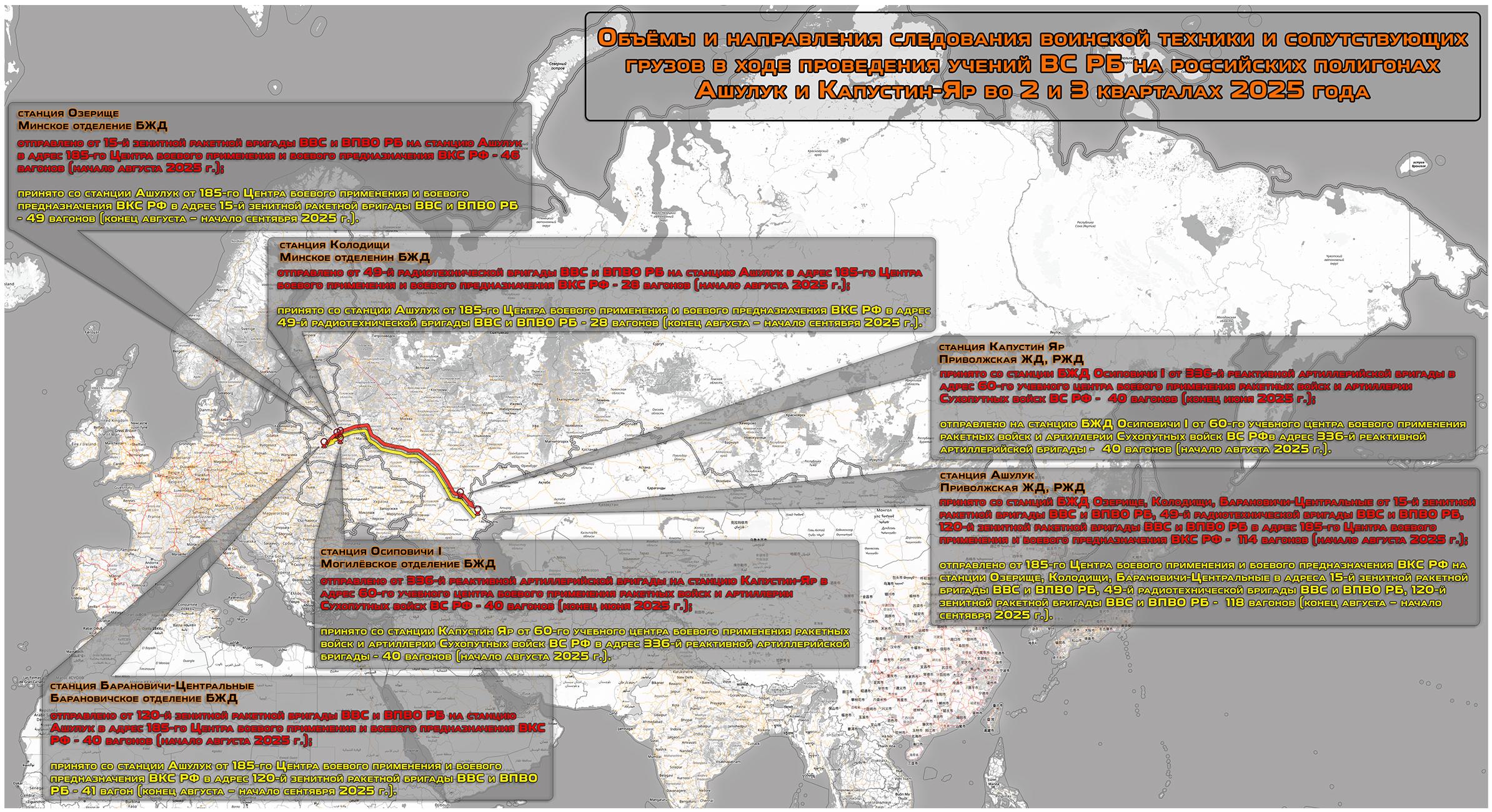
Between June and September 2025, organized rail transport of Air Force and Air Defense units of the Republic of Belarus, as well as rocket artillery of the Ground Forces of the Republic of Belarus, to the Russian training grounds Ashuluk and Kapustin Yar was recorded for combat training, qualification firing, and combat training activities under Russian programs.
In total, during the specified period, four outbound and four return troop trains were formed, ensuring the movement of three Belarusian air defense brigades and one rocket artillery brigade. The routes, train consists, and nature of the transported property indicate that the activities were conducted within the framework of planned annual combat training practice and deep integration of Belarusian units into the training system of the Aerospace Forces and Ground Forces of the Russian Federation.
7.1. The departure (withdrawal) of Air Force and Air Defense units of the Republic of Belarus to the Ashuluk training ground was carried out by three troop trains in early August 2025; the return (import) to Belarus to permanent deployment points was also completed by three trains in late August – early September 2025:
7.1.1. From Ozerishche station (Minsk Division of Belarusian Railway), a troop train of the Armed Forces of the Republic of Belarus, consisting of 46 railcars (excluding passenger cars with personnel), was dispatched from the 15th Anti-Aircraft Missile Brigade of the Air Force and Air Defense of the Republic of Belarus (military unit 30151) to Ashuluk station (Privolzhskaya Railway) for the 185th Combat Application and Combat Purpose Center of the Aerospace Forces of the Russian Federation (military unit 28004). This included: 41 flatcars with military equipment loaded, 3 gondola cars with explosive materials (transport-packaging containers with missiles for S-300/400 air defense systems), and 2 boxcars with gear.
The troop train of the 15th Anti-Aircraft Missile Brigade returned from the exercises to the Republic of Belarus in late August – early September 2025 with an altered consist: the train now comprised 49 railcars (+3 railcars), including 41 flatcars with military equipment loaded, 4 gondola cars with explosive materials (transport-packaging containers with missiles for S-300/400 air defense systems), 2 gondola cars with other unspecified cargo (empty transport-packaging containers for S-300/400 air defense system missiles), and 2 boxcars with gear.
7.1.2. From Kolodishchi station (Minsk Division of Belarusian Railway), a troop train of the Armed Forces of the Republic of Belarus, consisting of 28 railcars (excluding passenger cars with personnel), was dispatched from the 49th Radio-Technical Brigade of the Air Force and Air Defense of the Republic of Belarus (military unit 39872) to Ashuluk station (Privolzhskaya Railway) for the 185th Combat Application and Combat Purpose Center of the Aerospace Forces of the Russian Federation (military unit 28004). This included: 27 flatcars with military equipment loaded and 1 boxcar with gear.
The troop train of the 49th Radio-Technical Brigade returned from the exercises to the Republic of Belarus in late August – early September 2025 with a consist identical to that dispatched.
7.1.3. From Baranovichi Tsentralnye station (Baranovichi Division of Belarusian Railway), a troop train of the Armed Forces of the Republic of Belarus, consisting of 40 railcars (excluding passenger cars with personnel), was dispatched from the 120th Anti-Aircraft Missile Brigade of the Air Force and Air Defense of the Republic of Belarus (military unit 96577) to Ashuluk station (Privolzhskaya Railway) for the 185th Combat Application and Combat Purpose Center of the Aerospace Forces of the Russian Federation (military unit 28004). This included: 36 flatcars with military equipment loaded, 2 gondola cars with explosive materials (transport-packaging containers with missiles for S-300/400 air defense systems), and 2 gondola cars with gear.
The troop train of the 120th Anti-Aircraft Missile Brigade returned to the Republic of Belarus from the exercises in late August – early September 2025 with a modified consist: the total number of railcars in the train became 41 railcars (+1 railcar), including 36 flatcars loaded with military equipment, 2 gondola cars with other goods not listed in the alphabet (empty transport-packaging containers for S-300/400 SAM system missiles), 2 boxcars with equipment, and 1 gondola car with explosive materials (transport-packaging containers with missiles for S-300/400 SAM systems).
The Republic of Belarus annually deploys its main air defense units to the Russian Ashuluk range to conduct live firing from S-300PS, S-300V, and S-400 systems and to practice coordination between radar and anti-aircraft missile units. In 2025, the units deployed for the exercises included three specialized brigades of the Air Force and Air Defense Forces of the Republic of Belarus — the 15th Anti-Aircraft Missile Brigade, 49th Radar-Technical Brigade, and 120th Anti-Aircraft Missile Brigade, which corresponds to the established practice of rotational training of Belarusian air defense forces at the 185th Combat Employment and Combat Purpose Center of the Russian Aerospace Forces.
7.2. The deployment (export) of rocket artillery units of the Armed Forces of the Republic of Belarus to the Kapustin Yar range was carried out by one troop train in late June 2025, and the return (import) back to permanent deployment locations was completed in early August 2025 by the same train in identical consist:
– From Osipovichi I station (Mogilev Division of the Belarusian Railway) from the 336th Rocket Artillery Brigade (military unit 12180) to Kapustin-Yar station (Privolzhskaya Railway) addressed to the 60th Training Center for Combat Employment of Missile Troops and Artillery of the Ground Forces of the Russian Armed Forces (military unit 47209), a troop train of the Armed Forces of the Republic of Belarus was dispatched, consisting of 40 railcars (excluding passenger cars with personnel), of which: 36 flatcars loaded with military equipment, 3 boxcars with equipment, 1 gondola car with explosive materials (presumably transport-packaging containers with missiles for the Polonez MLRS).
The troop train of the 336th Rocket Artillery Brigade returned from the exercises to the Republic of Belarus in early August 2025 in a consist completely identical to the one dispatched.
Belarusian rocket artillery units are annually deployed to the Russian Kapustin Yar range to perform practical launches and live firing from the Polonez MLRS and other missile and artillery systems, since the necessary ranges and technical capabilities for such exercises are not available in the Republic of Belarus. In 2025, the 336th Rocket Artillery Brigade — the main formation of the Belarusian Missile Troops and Artillery equipped with extended-range MLRS — traditionally participated in the exercises.
VIII. Transport of Russian Troops to Belarus and Back as Part of the Zapad-2025 Exercises and CSTO Exercises (Vzaimodeystviye-2025, Poisk-2025, Eshelon-2025)
In August 2025, railway transport of Russian military units arriving to participate in the joint strategic exercises Zapad-2025, as well as in the Collective Security Treaty Organization exercises — Vzaimodeystviye-2025, Poisk-2025, and Eshelon-2025 — was carried out to the territory of the Republic of Belarus.
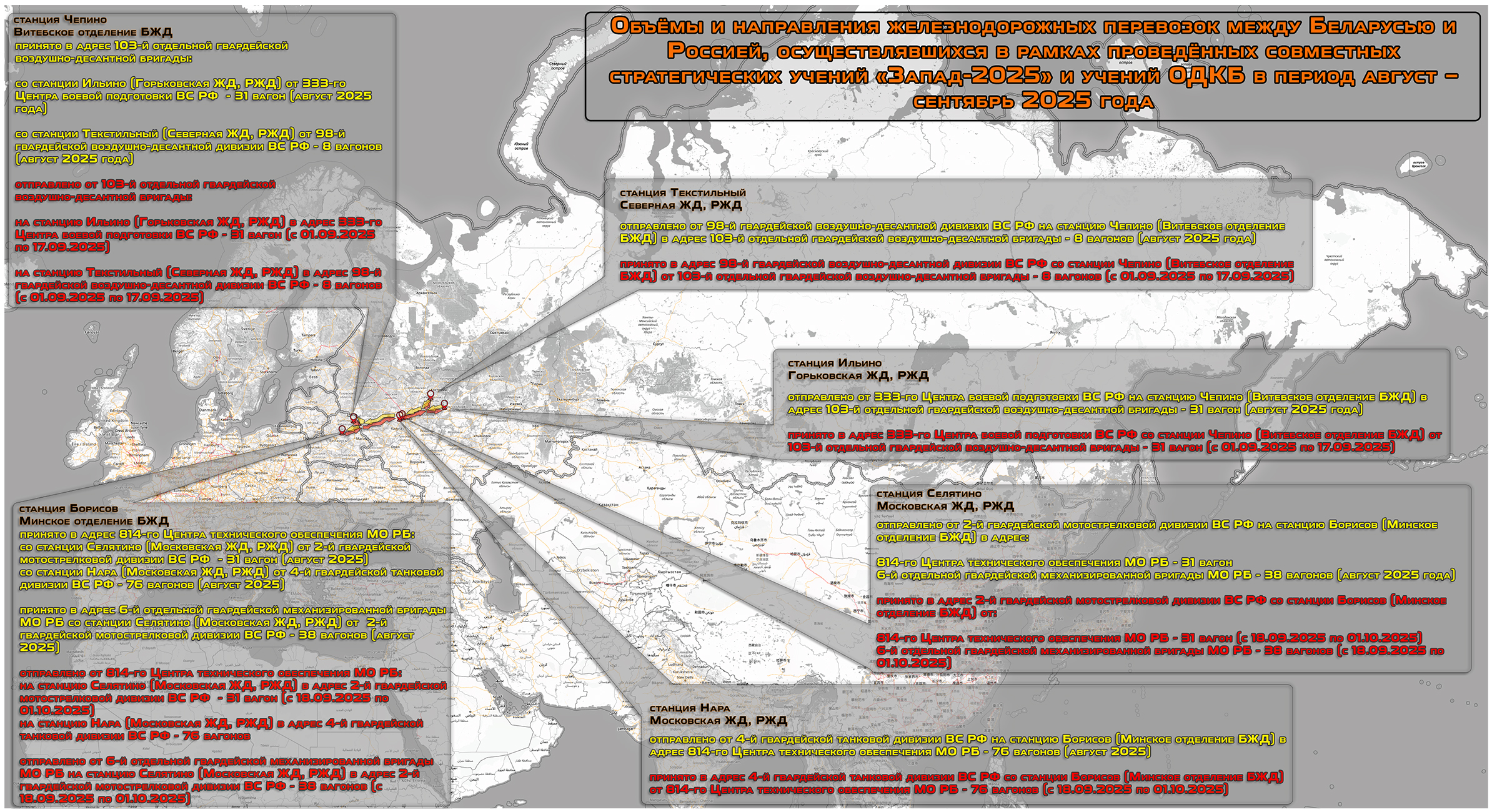
In total, in August–September 2025, six troop trains were deployed, transporting units of the 2nd Guards Motor Rifle Division, 4th Guards Tank Division, 333rd Combat Training Center of the Russian Armed Forces, and 98th Guards Airborne Division. All trains were processed according to the standard interstate military transport scheme: they arrived at stations of the Minsk and Vitebsk Divisions of the Belarusian Railway, were unloaded at infrastructure of the Ministry of Defence of the Republic of Belarus, and after completion of the exercises returned to the Russian Federation in a consist identical to the one that arrived.
Detailed data for each troop train that arrived and subsequently left the territory of Belarus are presented below.
8.1. Transport of Russian units for participation in the Zapad-2025 joint strategic exercises:
8.1.1. August 2025 — arrival (excluding passenger cars with personnel)
– From Selyatino station (Moscow Railway), the 2nd Guards Motor Rifle Division of the Russian Armed Forces (military unit 23626) sent a troop train to Borisov station (Minsk Division of Belarusian Railway) for the 814th Technical Support Center of the Ministry of Defence of the Republic of Belarus (military unit 32377). It consisted of 31 railcars: 28 flatcars with military equipment, 2 boxcars with gear and 1 boxcar with EM (explosive materials).
8.1.2. August 2025 — arrival (excluding passenger cars with personnel)
– From Selyatino station (Moscow Railway), the 2nd Guards Motor Rifle Division of the Russian Armed Forces (military unit 23626) sent a troop train to Borisov station (Minsk Division of Belarusian Railway) for the 6th Separate Guards Mechanized Brigade of the Ministry of Defence of the Republic of Belarus (military unit 05733). It consisted of 38 railcars: 35 flatcars with military equipment, 2 boxcars with gear and 1 boxcar with EM.
Return to permanent deployment locations in the Russian Federation: both trains (8.1.1 and 8.1.2) left the territory of the Republic of Belarus during the period 18.09.2025–01.10.2025 in a consist identical to the one that arrived.
8.1.3. August 2025 — arrival (excluding passenger cars with personnel)
– From Nara station (Moscow Railway), the 4th Guards Tank Division of the Russian Armed Forces (military unit 19612) sent two troop trains to Borisov station (Minsk Division of Belarusian Railway) for the 814th Technical Support Center of the Ministry of Defence of the Republic of Belarus (military unit 32377), with a total of 76 railcars: 66 flatcars with military equipment, 7 boxcars with gear and 3 boxcars with EM.
Return to the Russian Federation: the trains of the 4th Guards Tank Division left the territory of the Republic of Belarus during the period 18.09.2025–01.10.2025 in a consist identical to the one that arrived.
8.2. Transport of Russian units for participation in CSTO exercises (Vzaimodeystviye-2025, Poisk-2025, Eshelon-2025):
8.2.1. August 2025 — arrival (excluding passenger cars with personnel)
– From Ilyino station (Gorky Railway), the 333rd Combat Training Center of the Russian Armed Forces (military unit 74036) sent a troop train to Chepino station (Vitebsk Division of Belarusian Railway) for the 103rd Separate Guards Airborne Brigade (military unit 52287). It consisted of 31 railcars: 30 flatcars with military equipment and 1 boxcar with gear.
Return to the Russian Federation: the train left the Republic of Belarus during the period 01.09.2025–17.09.2025 in a consist identical to the one that arrived.
8.2.2. August 2025 — arrival (excluding passenger cars with personnel)
– From Tekstilny station (Northern Railway), the 98th Guards Airborne Division of the Russian Armed Forces (military unit 65451) sent a troop train to Chepino station (Vitebsk Division of Belarusian Railway) for the 103rd Separate Guards Airborne Brigade (military unit 52287). It consisted of 8 railcars: 6 flatcars with military equipment and 2 boxcars with gear.
Return to the Russian Federation: the train left the Republic of Belarus during the period 01.09.2025–17.09.2025 in a consist identical to the one that arrived.
A comparison of the recorded transport of Russian equipment and materiel as part of the Zapad-2025 joint strategic exercises and CSTO exercises shows that the scale in 2025 was the smallest in the entire history of such events.
If we consider only the trains involved in the Zapad-2025 joint strategic exercises, their total consist amounts to 145 railcars, approximately 150. For comparison: during the Zapad-2021 exercises alone, a total of 1,286 railcars were deployed to the territory of the Republic of Belarus, including 1,094 flatcars with equipment, 100 passenger cars, 88 boxcars, of which 44 carried explosive materials, as well as 4 gondola cars with explosive materials.
Including the two additional trains that arrived as part of the CSTO exercises, the total volume of Russian railcars in August–September 2025 amounts to 184 units, which is still fundamentally smaller than the scale of Zapad-2021.
The difference in scale is approximately seven to nine times.
The structure of the trains that arrived in 2025 also indicates the absence of expanded logistical flows: the consists were small, limited in nomenclature, and did not include large batches of explosive materials or extensive technical support units characteristic of previous Zapad joint strategic exercise cycles.
The CSTO exercises conducted simultaneously were similarly small in scale: only two trains of small consist to Chepino station.
- Related materials:
Volumes of Import and Export of Ammunition from the Territory of Belarus in September 2025;
Is Belarus Resuming the Export of Ammunition from its Arsenals for the Needs of the Russian Armed Forces?;
A Large Batch of Ammunition Has Been Imported from Russia to Belarus;
Delivery of Russian Military Personnel, Equipment, and Weapons for the Zapad-2025 Exercises Will Begin Soon via the Belarusian Railway;
Export of Products from Belarus for Strategic Facilities of the Russian Federation and Import of Russian Armed Forces Equipment to Belarus — Q1 2025;
Export volumes of railway cargo to Russia for 2024: MZKT and military cargo;
Railway Deliveries of Weapons from Russia to Belarus: Data for Q4 and Results for 2024;
Import of Russian Weapons and Ammunition to Belarus by Railway Transport for 9 Months of 2024;
Ammunition Was Exported by Railway from Belarus to Attacked Arsenals in Russia;
Logistics of the Invasion: Who and How Delivered the “War”;
Information on the Export of Ammunition from Storage Arsenals of the Republic of Belarus for 2022 and Early 2023;
Amount of Military Equipment Transferred by the Republic of Belarus to the Armed Forces of the Russian Federation in October 2022.